

The Information Isn’t the Problem
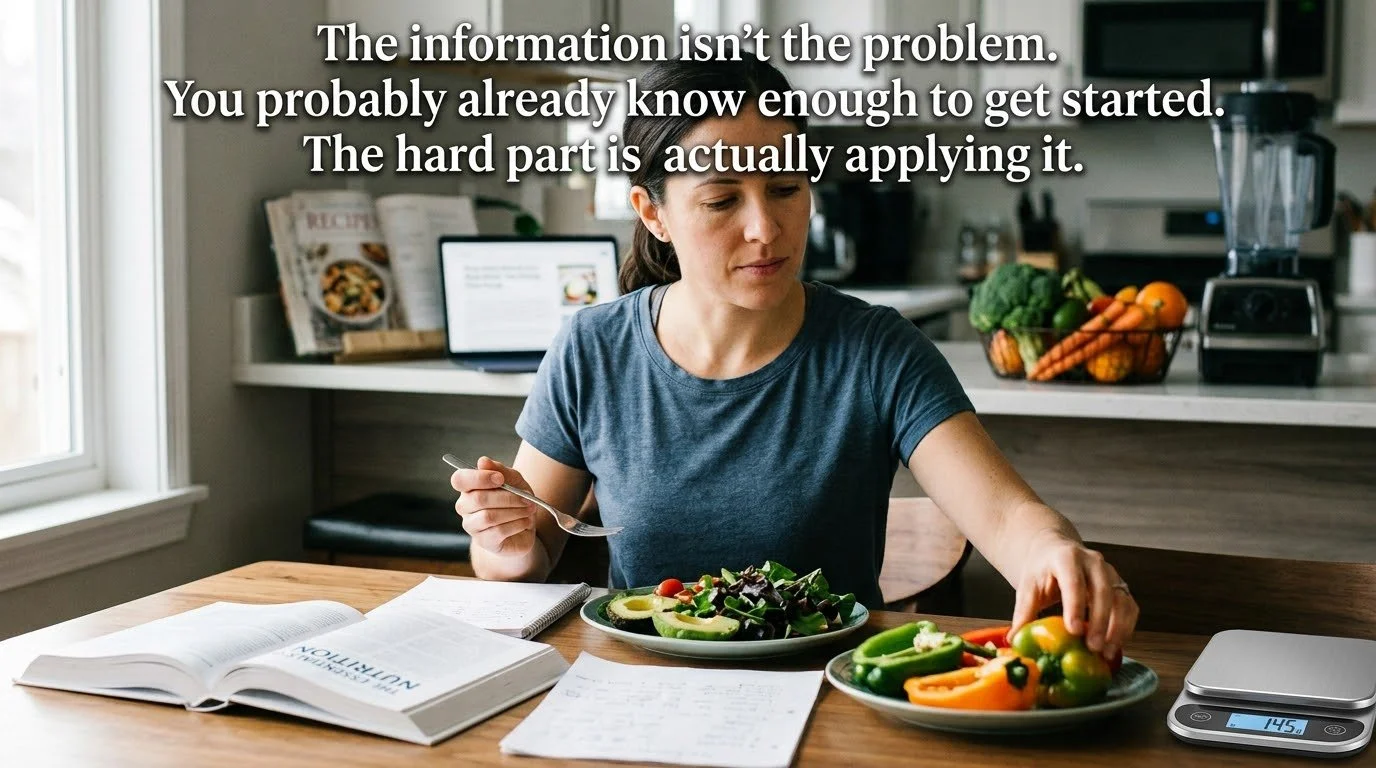
The math and science have already been done.
You just need to apply the information.
We get tricked and confused by all the health studies, diet names, food rules, trends, and conflicting advice. But when you strip all of that away, most approaches that actually work come back to some basic principles:
Control your calories. Eat mostly real food. Get regular movement. Get enough sleep. Repeat.
That doesn’t mean everyone’s diet has to look exactly the same. It means the core principles are remarkably similar.
The part that took me years to understand wasn’t finding more information.
It was finally applying the information I already had.
I heard versions of the same advice for more than a decade. Then eventually, someone explained it in a way that finally clicked for me.
And once it clicked, I stopped constantly looking for another answer and started doing something with the information.
Yes, I’ve had to make adjustments along the way.
And I still do.
But the foundation hasn’t really changed.
Find the Thing That Makes It Click
For you, it might be a book.
It could be an article, podcast, YouTube video, or conversation with a coworker, friend, or family member.
At some point, you may hear something you’ve heard before, but this time it makes sense.
That’s the moment you should take advantage of.
Don’t just say, “That sounds good.”
Start applying it.
A lot of us spend years saying:
“That’s too hard.”
“I don’t have time.”
“I can’t eat like that.”
“I’ll start Monday.”
“I need to find the right diet first.”
I understand because I’ve said versions of those things myself.
But eventually you have to stop negotiating with yourself and start building the habits.

You Can’t Bulk Your Way Out of Being Overweight
If your goal is to look lean, toned, and muscular, you have to understand where you are starting.
You can’t simultaneously tell yourself:
“I want to lose the extra body fat, but I also want to eat in a significant surplus so I can bulk up.”
At some point, you have to get lean enough to see what you’ve actually built.
For some people, that means cutting first.
Then you can maintain for a while.
Then, if adding more muscle is the goal, you can increase calories strategically. If you gain more body fat than you want, you can go back into a slight deficit.
It’s a process.
And you will have to make adjustments over time.
That’s normal.
Your body changes. Your activity changes. Your goals change. Your lifestyle changes.
The difference is that once you understand the basic numbers, you aren’t making adjustments blindly.
You have the data.
You can look at your weight, waist measurement, calories, protein, activity, and how your body looks and feels. Then you can make an educated adjustment instead of jumping from one diet or program to another.
That’s one of the biggest benefits of learning the fundamentals.
You don’t need someone to tell you what to do every time something changes.
You can look at your own information and make a reasonable decision.
You Probably Don’t Need to Weigh 200 Pounds
One thing I’ve noticed, especially with men, is that a lot of us have a distorted idea of what we need to weigh to look muscular.
Some guys think they need to be 200 pounds—or more—to have noticeable muscle and look strong.
That’s not necessarily true.
Unless you’re a bodybuilder, professional athlete, very tall, or simply someone whose genetics and goals put you in a heavier range, you may be surprised by how much someone actually weighs.
For many men under 6 feet tall, a healthy and muscular physique may fall somewhere around the 140s through the 180s or even around 190, depending on height, frame, muscle mass, and body-fat percentage.
And this is where you can get humbled—in a good way.
You might see a guy who looks absolutely ripped and assume he weighs 180 or 190 pounds.
Then you find out he’s 165 pounds with a 30- or 31-inch waist.
That’s when you realize that the number on the scale isn’t telling the whole story.
Muscle, body-fat percentage, waist measurement, height, and body composition matter.
So instead of picking an arbitrary goal weight because it sounds muscular, find someone who is around your height and has the general look you’re trying to achieve.
Then pay attention to their numbers.
For women, do the same thing.
Find women around your height with a physique similar to what you’re trying to achieve and learn what their weight and waist measurements are.
Women of the same height as men will often have a somewhat lower weight range because of differences in body composition, but there is still a wide range based on frame, muscle mass, and body-fat percentage.
The goal isn’t to copy someone else’s exact numbers.
It’s to give yourself a realistic frame of reference.
You may discover that the body you want doesn’t require you to lose nearly as much weight—or gain nearly as much—as you thought.
Once you know your own numbers, you can establish a reasonable range rather than chasing one magic number.
And give yourself some room.
A 5–10 pound cushion around your target can be much more realistic than believing you have to maintain one exact number forever.
Know Your Numbers
Once you know your basic numbers, everything gets easier.
Know approximately:
Your maintenance calories
Your calorie range for losing fat
Your protein target
Your height and realistic weight range
Your waist measurement
Your activity level
Your average daily movement
You don’t have to obsess over every number forever.
You just need to understand what they mean.
Then start stacking habits.
One habit becomes two.
Two become three.
Eventually, they aren’t things you have to constantly think about. They’re simply part of your daily and weekly routine.
That’s when this gets easier.
Learn to Read the Label
Once you can actually read a food label, a lot of the confusion disappears.
And this is something people of every age should understand.
Know what the actual serving size is.
If the serving size says one ounce and you eat three ounces, you didn’t eat one serving.
You ate three.
That sounds obvious, but it’s one of the easiest ways people underestimate how much they’re eating.
You don’t have to weigh every bite of food forever.
But when you understand serving sizes and portions, you eventually get much better at eyeballing your food.
That’s the goal.
Knowledge first. Experience second.
Don’t Try to Be Perfect
I’m not trying to tell you that you can never eat a cookie, hamburger, fries, pizza, or whatever food you enjoy.
That’s not realistic for most people.
Instead, I’d aim for something like 80% or more of your diet coming from mostly whole, minimally processed foods and single-ingredient foods from both plant and animal sources.
Then leave some room for the foods you enjoy.
That’s where your label-reading skills come back into play.
You can look at the calories, protein, carbohydrates, fat, serving size, and ingredients and figure out how to make something fit.
But there’s a big difference between having a portion of something you enjoy and turning it into an all-day free-for-all.
Don’t eat the entire bag of cookies because you decided you’ve “earned a cheat day.”
That’s not the point.
Give Your Taste Buds a Reset
If you’re coming from a diet that’s heavily based on ultra-processed foods, I actually think there’s value in going 100% real food for a couple of weeks before worrying about how to fit treats back into your diet.
Give yourself a reset.
Eat meat, fish, eggs, vegetables, fruit, beans, whole grains, nuts, seeds, and other minimally processed foods that work for your particular goals.
Do that consistently for two or three weeks—or longer.
Then go back and eat some of the ultra-processed foods you used to love.
You may be surprised.
Something that used to taste amazing might suddenly taste way too sweet, too salty, too oily, or just...off.
You may start tasting things you didn’t notice before.
That’s because your palate can change.
And once you start enjoying real food more, you don’t necessarily have to fight yourself as much to stay away from the other stuff.
Don’t Make Fast Food Your Starting Point
If you’re trying to establish better habits, eating McDonald’s—or whatever your favorite fast-food restaurant is—once or twice a week probably isn’t the first habit I’d focus on.
Not because you can never eat it.
But because you haven’t given yourself enough time to build the foundation.
Build the good habits first.
Then learn how to navigate restaurants, travel, holidays, social events, and busy days without completely abandoning them.
That’s where your label-reading and portion-control skills become useful.
You don’t need to eat perfectly.
You need to know how to make better choices when perfect isn’t an option.
Your Environment Matters
Here’s one of the simplest rules I’ve learned:
If it’s in your house, eventually it’s probably going in your mouth.
So set your environment up for success.
If you know you can’t eat one cookie and stop, don’t keep an open package of cookies sitting on the kitchen counter.
If you want to eat more vegetables, buy vegetables and make them easy to prepare.
If you want to eat more protein, keep convenient protein sources available.
Make the good choice the easy choice.
Stop relying entirely on willpower.
Your environment is part of your diet.
You Can Change the Family Pattern
This is bigger than losing a few pounds.
You can be the person who changes the health trajectory of your family.
Or you can be the person who continues the same habits that have been passed down for generations.
Bad eating habits don’t have to become family traditions.
Neither does being inactive.
Neither does constantly gaining weight as you get older.
You can be the person who decides:
It stops with me.
And you don’t have to change everything tomorrow.
Learn something.
Apply it.
Stack another habit.
Measure your results.
Make adjustments when the data tells you to.
Keep going.
That’s really what getting lean, getting healthy, and staying healthy comes down to.
The information isn’t some secret.
The math isn’t magic.
The diet doesn’t need a fancy name.
Learn the basics. Apply the basics. Build the habits. Use your data to adjust.
And eventually, what once felt hard starts feeling normal.
*Health and fitness information shared here is for general educational purposes and is not medical advice. Individual nutrition and exercise needs vary, and you should consult an appropriately qualified healthcare professional for advice specific to your situation.
Thanks for reading The Deep Dive!
What do you think?
Have a thought about this Deep Dive? I'd love to hear it.
Email me at thedeepdive@touchesoftech.com and let me know what you think—or send along an idea for something you'd like to see explored in a future Deep Dive.
I can't promise I'll write about every suggestion, but I'm always interested in hearing what you're curious about.
Get new Dives and The Deep Dive: This Week's Dives delivered straight to your inbox each weekend.
📧 Subscribe
You'll be taken to our current newsletter provider to complete your free subscription.