

Urbanism: Once You See It, You Can’t Unsee It
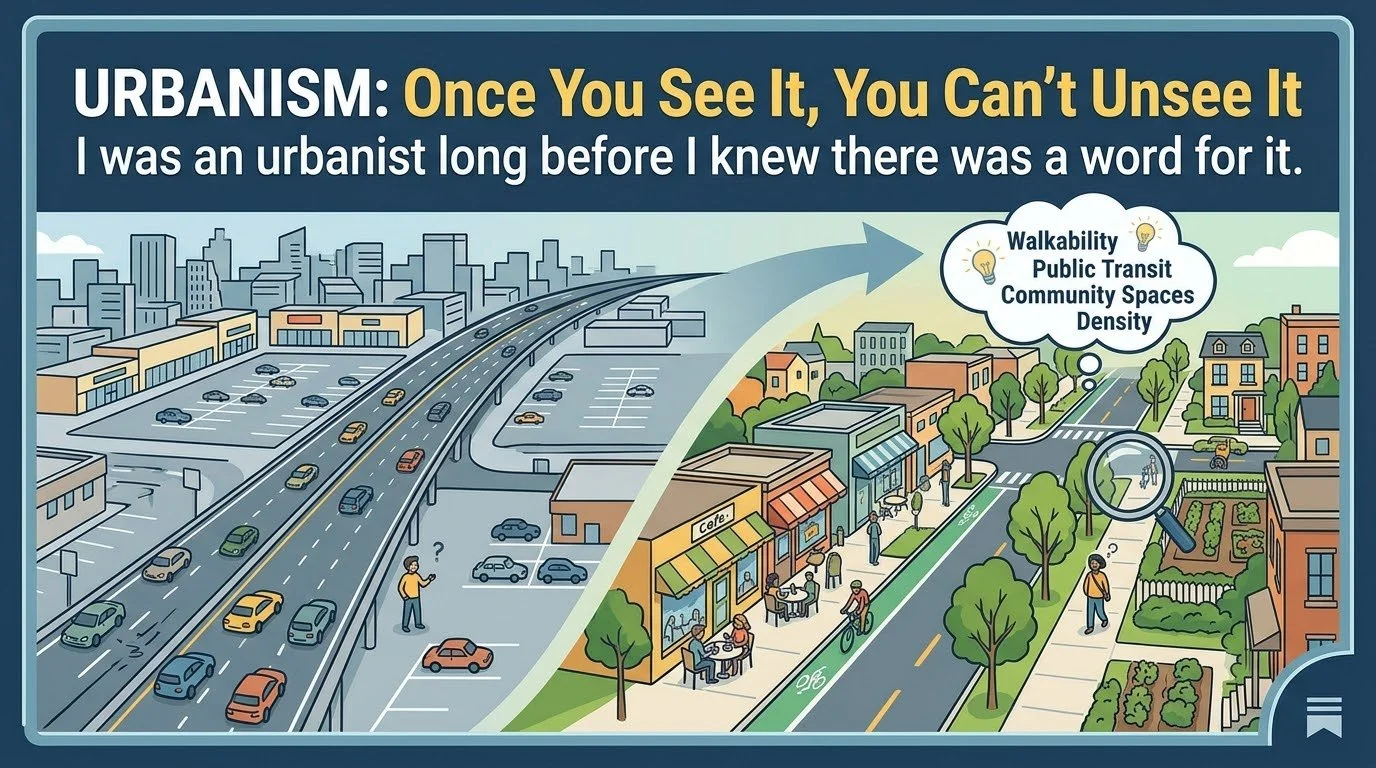
Urbanism: Once You See It, You Can’t Unsee It
I was an urbanist long before I knew there was a word for it.
What is urbanism?
That’s probably the first question I should answer.
Urbanism is, broadly speaking, the study and practice of how we design and build our towns and cities—and how those places affect the way we live.
But for me, it started long before I knew there was a word for it.
I’ve always valued good design.
I’ve always liked mixed-use developments. I like the idea of being able to walk somewhere instead of automatically getting in a car. I’ve always enjoyed hearing my parents and grandparents talk about growing up when they could walk to most of the places they needed to go.
There were corner stores everywhere.
There were gathering places.
There were what we now call third places—places that aren’t home, school, or work where people naturally spend time together.
Coffee shops. Restaurants. Parks. Bars. Libraries. Community spaces. Small businesses.
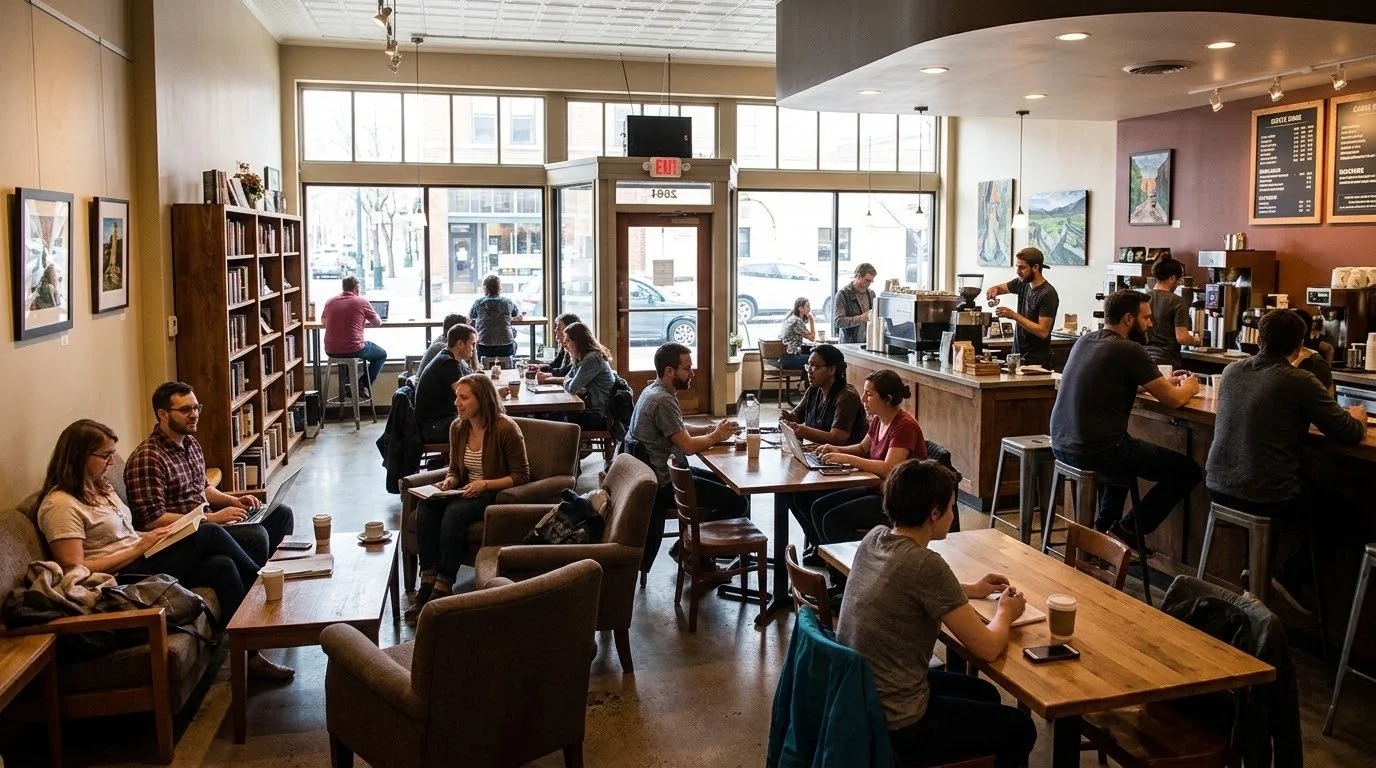
We still have those things in America, of course.
But outside of places with extensive public transportation and walkable neighborhoods, you often have to be much more intentional about finding them.
And I’ve always been fascinated by how places are built.
I can watch a construction project from the first piece of dirt being moved all the way through the final building opening and be completely fascinated by it.
For years, I didn’t really know why.
Then a few years ago, I discovered urbanism.

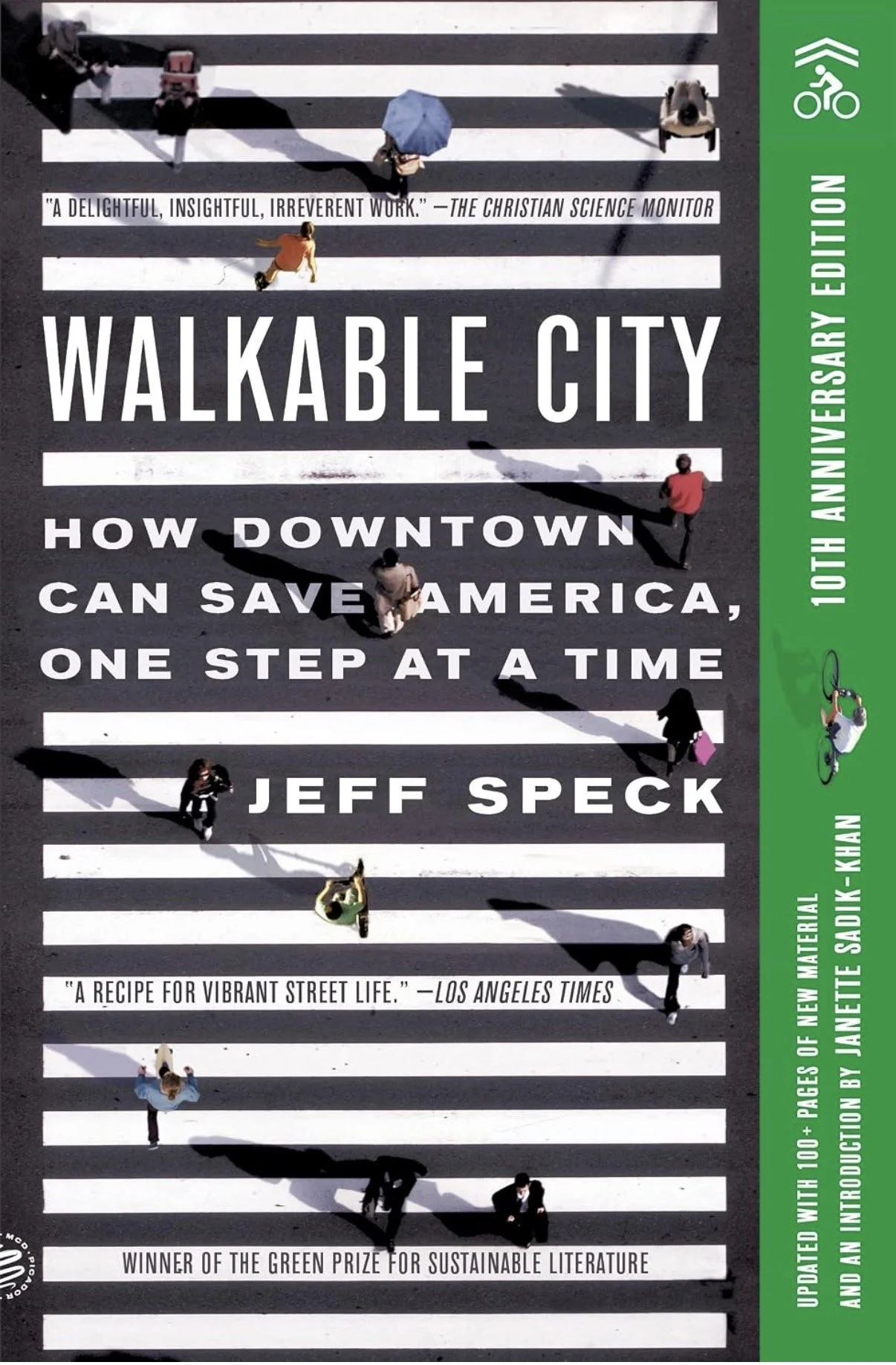
I discovered organizations like Strong Towns, writers like Jeff Speck, and a whole world of people talking about something I had apparently been interested in my entire life.
And then I did what I always do.
I went down the rabbit hole.
Once you start asking why, things get interesting.
I wanted to know where all of this came from.
Why did American cities develop the way they did?
Why are so many neighborhoods designed around cars?
Why are houses separated from stores, restaurants, schools and offices?
Why did we build enormous shopping malls surrounded by parking lots?
Why did so many streetcar systems disappear?
And why does so much of America look completely different from the neighborhoods my parents and grandparents describe growing up in?
That’s when I started learning about the suburban experiment.
I learned about the history of shopping malls.
I learned about streetcars and how many American cities once had extensive streetcar networks.
I learned about highways being built through established neighborhoods and communities.
I learned about induced demand—the idea that building more road capacity can encourage more people to drive, eventually bringing congestion back.
And the deeper I went, the more I realized something:
This isn’t just about buildings.
It’s about how we live.
The suburb was supposed to be an option.
There’s nothing inherently wrong with suburbs.
That’s important to say.
Suburban living works very well for some people.
The problem is when one type of development becomes the default—and everything else becomes an afterthought.
When I say “suburb,” I’m not talking about every neighborhood outside a downtown.
I’m talking about the kind of development where you can drive for miles and see nothing but houses.
No store.
No coffee shop.
No restaurant.
No school.
No park you can realistically walk to.
No transit.
Nothing.
Just houses and roads.
Then eventually you reach a commercial area where everything is surrounded by enormous parking lots.
That shouldn’t be our only model.
Imagine neighborhoods where different types of housing actually exist together.
Apartments.
Townhouses.
Row houses.
Duplexes.
Small multifamily buildings.
Single-family homes.
You can still have a yard.
You just don’t necessarily need an acre of land.
You could have a decent front yard and backyard while also having shared green space where kids can play and neighbors can gather.
You could walk to a coffee shop.
Walk to a restaurant.
Walk to a local bar.
Walk to a small grocery store.
Walk to a park.
Walk to a school.
And when walking isn’t practical, you have transportation options.
Streetcars.
Light rail.
Subways where appropriate.
Buses.
Bike infrastructure.
And yes, Uber and Lyft can still exist.
The point isn’t to eliminate cars.
Cars should be an option rather than a requirement for simply participating in everyday life.
That’s a major difference.
And housing doesn’t have to look one particular way.
I also think we need to break free from the idea that there is one definition of the American dream.
For generations, we’ve been sold a very specific picture:
A detached house.
A driveway.
A garage.
A big yard.
A white picket fence.
And somehow, that became the standard against which everything else was measured.
If you live in an apartment, people assume you’re struggling.
If you live in a townhouse, you must be settling.
If you rent instead of own, you’re somehow behind.
Why?
Maybe someone likes living in an apartment.
Maybe they don’t want a yard to maintain.
Maybe they want to live close to restaurants, entertainment and public transportation.
Maybe they want to spend their money on experiences instead of a larger house.
Maybe they want to live with their parents.
Maybe their parents want to live nearby.
Maybe a multigenerational neighborhood makes more sense for their family.
Housing is supposed to serve people.
People aren’t supposed to organize their entire lives around fitting into one housing model.
And there are more people who are house poor or car poor than we probably realize.
Sometimes the biggest house isn’t the best house.
Sometimes the biggest yard isn’t the best yard.
Sometimes owning a home isn’t automatically the best financial decision.
And sometimes renting is exactly what someone wants.
Infill development makes sense.
This is why I don’t automatically understand the outrage whenever a new apartment building or mixed-use development goes up.
“More apartments!”
“Where are all these people going to park?”
“Traffic is going to be terrible!”
Those are legitimate questions worth asking about any development.
But they’re not the entire conversation.
Infill development can make much more efficient use of infrastructure that already exists.
Instead of extending roads, utilities and other infrastructure farther and farther outward, you can add people and businesses to places that already have infrastructure.
And mixed-use development can be particularly interesting.
Retail on the bottom.
Apartments above.
Maybe offices nearby.
Restaurants.
Coffee shops.
Parks.
Entertainment.
Housing.
All within the same general area.
That’s a completely different environment from a strip mall surrounded by a sea of parking.
And please don’t get me started on the parking argument.
People will figure out how to park.
People will figure out how to get where they need to go.
The bigger question is:
Why does every person have to arrive in a two-ton vehicle for a neighborhood to function?
Density isn’t the enemy.
We don’t need every piece of land covered with apartment buildings.
We also don’t need every new development to be a massive single-family subdivision miles from everything else.
There’s a middle ground.
And that’s where I think a lot of the interesting development is happening.
You can have density without creating a concrete jungle.
You can have apartments next to single-family homes.
You can have townhouses next to duplexes.
You can have retail near residential.
You can have parks and green space.
You can have people living, working, shopping and playing in the same general area.
And that creates something incredibly valuable:
foot traffic.
A neighborhood with people in it throughout the day is fundamentally different from a shopping center that only comes alive when people drive there.
People living there.
People working there.
People walking around.
People eating.
People shopping.
People taking their kids to the park.
People sitting outside a coffee shop.
That’s what creates life.
And, to a certain degree, eyes on the street.
You don’t need to rely entirely on people driving past a place to notice what’s happening.
There are people already there.
Then there’s transportation.
This is where the American development pattern gets even more complicated.
If you’ve spread everything out, you have created a transportation problem.
The grocery store is three miles away.
The school is two miles away.
Your job is 15 miles away.
The restaurant is five miles away.
The nearest hospital is another 20 minutes down the highway.
So what do you do?
You drive.
Of course you drive.
Then we look at traffic and say:
“We need more lanes.”
So we build more lanes.
For a while, traffic improves.
Then more people drive.
Eventually, those lanes fill up.
So we build more.
And the cycle continues.
Part of the reason this happens is because we’ve designed communities where driving is often the only practical option.
If everything is spread out, public transportation becomes harder and more expensive to provide.
If destinations are close together, walking, biking and transit become much more practical.
That’s not ideology.
That’s geometry.
Even shopping malls tell part of this story.
One of the most interesting rabbit holes I went down was the history of the indoor shopping mall.
The original idea wasn’t necessarily to create the dead commercial landscapes we see today.
The concept evolved.
And then the mall became one of the defining features of American suburban life.
For a while, it worked incredibly well.
Then things changed.
Retail changed.
Consumer behavior changed.
Online shopping arrived.
Some malls adapted.
Some didn’t.
And many disappeared.
Strip malls face a similar challenge.
The basic idea isn’t necessarily bad.
Put businesses together so people can shop in one place.
The problem is that businesses need customers.
And customers need a reason to be there.
If you’ve got a strip mall surrounded by thousands of homes but nobody can realistically walk there, every business depends almost entirely on people getting into their cars.
Compare that with a neighborhood where people actually live above or next to those businesses.
Now you have built-in customers.
Breakfast before work.
Coffee in the morning.
Lunch.
Dinner.
A drink after work.
A quick grocery run.
A walk to the restaurant.
A walk home.
That’s a fundamentally different ecosystem.
Sports are figuring this out too.
You don’t even have to be an urbanist to see where professional sports are headed.
Look at stadium and arena development around the country.
More and more teams are realizing that a sports venue doesn’t have to be a giant building sitting in the middle of a parking lot.
It can be part of a neighborhood.
Restaurants.
Bars.
Hotels.
Retail.
Housing.
Entertainment.
Public spaces.
Offices.
A place that is alive when there isn’t a game.
The Premier League and many other parts of the UK have long had stadiums embedded directly into established neighborhoods.
American sports have historically done more of the opposite.
Build a massive stadium.
Build thousands of parking spaces.
Then leave.
That’s changing.
And you don’t have to be a diehard sports fan to understand why.
These venues are used for much more than sports now.
Concerts.
Events.
Community activities.
Restaurants.
Entertainment.
The stadium or arena can become an anchor for an entire district.
And I’m seeing this firsthand in Kansas City with the development around the Current.
And I’m watching the conversation around the Royals and downtown Kansas City the same way.
Some people see:
“No parking.”
“It’s going to be too loud.”
“What’s wrong with the stadium we’ve had for 50 years?”
I’m looking at what comes next.
I see steps two, three and four.
That’s the difference.
Some people are looking at the building. I’m looking at the ecosystem around the building.
Once everything is completed, I suspect some of the same people complaining about it today will eventually be downtown taking selfies and saying:
“Wow. This is amazing.”
Because that’s often how development works.
We judge the individual piece before we see what all the pieces become together.
Once you know the history, you can’t unsee it.
That’s probably the biggest thing urbanism has taught me.
Once you understand how cities were designed, you start noticing things everywhere.
You start noticing parking lots.
You start noticing setbacks.
You start noticing sidewalks that go nowhere.
You start noticing how far apart everything is.
You notice when a neighborhood has mixed housing.
You notice when people are actually walking.
You notice when a restaurant has outdoor seating facing a sidewalk versus a parking lot.
You notice when a development has apartments above retail.
You notice when a stadium is connected to a neighborhood instead of isolated from it.
You start appreciating good design even more.
And then you start asking the most important question:
Why?
Why did they build it this way?
Why is the road here?
Why is there no sidewalk?
Why are the houses so far apart?
Why is the grocery store three miles away?
Why did they tear out the streetcar?
Why did they build the highway through this neighborhood?
Why is this entire commercial district surrounded by parking?
Why are we building another subdivision 20 miles farther out?
Those questions matter.
Because the answers are usually more complicated than “that’s just how things are done.”
Don’t just follow the crowd.
This applies to more than urbanism.
I’ve become much more interested in understanding the why behind things.
Don’t just listen to what somebody tells you.
Do the homework.
Read the books.
Watch the videos.
Look at the history.
Find the original plans.
Look at what worked.
Look at what failed.
And, especially when it comes to your own community, pay attention to local government.
Attend meetings.
Watch city council meetings.
Look at development proposals.
Read planning documents.
Many cities make their meetings publicly available online.
You don’t have to become a city planner.
You don’t have to become an urbanist.
You don’t even have to agree with every Strong Towns argument, every planner or every development proposal.
But you should understand enough about how your city works to have an informed opinion about what happens there.
Because decisions about roads, zoning, housing, transit and development aren’t abstract.
They determine what your neighborhood looks like 10, 20 and 50 years from now.
Help is on the way—but it won’t happen overnight.
There are cities and developers experimenting with different approaches right now.
More infill.
More mixed-use development.
More missing-middle housing.
Better transit.
Walkable neighborhoods.
Redevelopment of underused commercial properties.
More housing options.
But decades of development patterns aren’t going to be reversed overnight.
We spent decades building outward.
We built highways through active communities.
We separated homes from businesses.
We made cars necessary.
We built enormous parking lots.
We expanded infrastructure farther and farther away from existing neighborhoods.
Undoing all of that is going to take time.
And some of it probably shouldn’t be undone.
The point isn’t to turn every American city into Manhattan.
The point isn’t to eliminate suburbs.
The point isn’t to make everyone live in an apartment.
The point is to give people more choices.
Want a single-family house?
Great.
Want a townhouse?
Great.
Want an apartment downtown?
Great.
Want a duplex?
Great.
Want to live somewhere you can walk to dinner?
Great.
Want to live somewhere you need a car?
That’s fine too.
But why should one lifestyle be treated as the default—and everything else as a compromise?
The American experiment went a little too far.
That’s ultimately where I land.
The suburban idea itself wasn’t necessarily bad.
Having options is good.
But somewhere along the way, the option became the default.
And the default became the system.
And the system became so normal that most of us stopped questioning it.
We just live our lives.
Drive to work.
Drive to school.
Drive to the store.
Drive to dinner.
Drive home.
Drive to the gym.
Drive to the park.
Drive to meet friends.
Then complain about traffic.
We don’t necessarily stop and ask whether the system itself could be designed differently.
That’s what urbanism made me start thinking about.
Maybe the goal shouldn’t be a city where everyone lives the same way.
Maybe the goal should be a city where more people have the ability to choose how they want to live.
Where families can live close together.
Where aging parents can remain independent while still being close to their children.
Where young adults can live near their jobs without spending a fortune on transportation.
Where kids can walk or bike somewhere without crossing six lanes of traffic.
Where you can walk to coffee.
Where you can meet your neighbors.
Where a local business can survive because people actually live around it.
Where a stadium can become part of a neighborhood instead of a parking lot with a building in the middle.
Where a car is useful—but not required for every basic activity.
That, to me, is what good urbanism is about.
Not eliminating cars.
Not eliminating houses.
Not eliminating suburbs.
Not forcing everyone into apartments.
Giving people choices.
And once you start looking at cities through that lens, something strange happens.
You start seeing everything differently.
You notice the parking lot.
You notice the missing sidewalk.
You notice the empty strip mall.
You notice the highway.
You notice the apartments going up.
You notice the coffee shop.
You notice the people walking.
You notice the stadium.
You notice the neighborhood around it.
And eventually you realize:
Once you know the history, you can’t unsee it.
Thanks for reading The Deep Dive!
What do you think?
Have a thought about this Deep Dive? I'd love to hear it.
Email me at thedeepdive@touchesoftech.com and let me know what you think—or send along an idea for something you'd like to see explored in a future Deep Dive.
I can't promise I'll write about every suggestion, but I'm always interested in hearing what you're curious about.
Get new Dives and The Deep Dive: This Week's Dives delivered straight to your inbox each weekend.
📧 Subscribe
You'll be taken to our current newsletter provider to complete your free subscription.